The Number Is Green. The Account Is About to Churn.
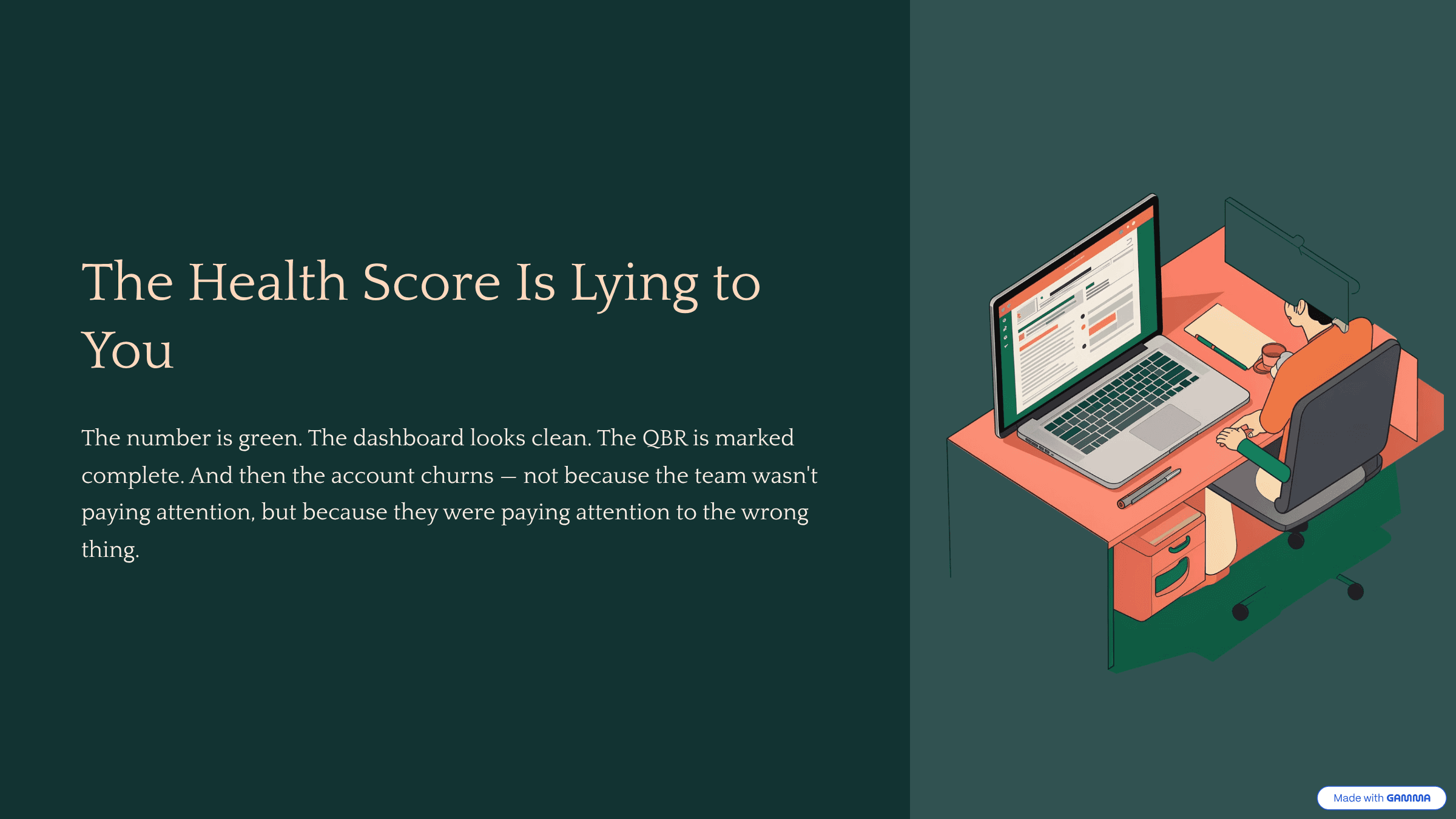
The number is green. The dashboard looks clean. The CSM just marked the QBR complete.
And then the account churns.
Not because the team wasn’t paying attention. Because they were paying attention to the wrong thing.
The score became the job
Health scores were supposed to solve a real problem.
CS teams at scale can’t maintain deep relationships with every account. You need some signal that tells you where to look. The idea made sense.
The execution became something else.
What most platforms built was a composite score — a weighted average of product usage, support tickets, NPS, and contract recency — and presented it as insight. Green means healthy. Red means at risk. Yellow means someone has to have an uncomfortable conversation.
The problem is that those inputs are proxies.
Product logins are not engagement. NPS is not loyalty. A quiet support queue doesn’t mean a happy customer; it might mean they’ve given up submitting tickets because nothing gets fixed.
The score is measuring the surface of the relationship, not the relationship itself.
And then there’s the lag. Most health score data is pulled and refreshed on cycles — daily at best, weekly in practice for many teams.
You’re not watching a customer. You’re reading a postcard they sent you three weeks ago.
The deeper issue is behavioral. Once you give CSMs a dashboard with a number on it, the number becomes the job.
The best CSMs spend more time understanding why the score says what it says than they spend talking to customers. The score becomes the object of care, not the account.
That’s not a people problem. That’s a systems problem.
Signals, not scores
The question isn’t how to build a better health score. It’s whether a single score is the right abstraction at all.
A number collapses nuance. Two accounts can both sit at 72 for completely different reasons.
One is a champion who went quiet after a reorg. The other is a power user who’s never expanded because no one has had the right conversation at the right time. Same score, completely different situations — and the right action for each is nothing alike.
What you actually need is a system that understands what’s happening in each account specifically, and tells the CSM what to do about it.
That means tracking signals, not scores.
A signal is a specific thing that happened: an executive sponsor left, a key integration stopped firing, usage in a module your renewal depends on dropped 40% in 30 days, a contact opened every email for three months and then stopped.
Each of those changes what a CSM should do today.
Signals are directional. Scores are positional. Direction is what matters when you’re trying to get ahead of a churn risk or an expansion opportunity.
This is why Sonora’s customer knowledge graph tracks relationships, events, and patterns across the book of business — rather than compressing everything into a single number.
When an executive champion leaves a Carta account, the system knows that. When a user at Merge hits a usage pattern that precedes either an expansion conversation or a disengagement, the system surfaces it. Not as a red flag on a dashboard. As a specific action with context behind it.
The goal is to give CSMs something they can act on, not something they have to interpret.
Instead of a CSM going into a QBR hoping the green score holds, they go in knowing that usage in the three modules the customer cares about most has been up for six weeks, that the champion was promoted last month, and that two other contacts just attended a webinar on a feature they haven’t adopted yet.
The conversation doesn’t start from a number. It starts from knowledge.
The teams that have made this shift describe the same thing: their CSMs stop talking about the score in weekly standups and start talking about accounts.
The score was never the goal. It was a proxy for a conversation the team didn’t have time to have. When the system does the synthesis work, the proxy becomes unnecessary.
What the best teams have already figured out
Health scores aren’t going away anytime soon. They’re too embedded in reporting structures, QBRs, and board decks.
But the best CS organizations have already started treating them as outputs of something deeper, not inputs to decision-making. They use a score to explain what happened, not to decide what to do.
The ones that haven’t made that shift yet are running CS the way airlines ran operations before real-time tracking: with yesterday’s information, watching a lagging indicator, and calling it situational awareness.
The accounts that are going to churn in Q3 aren’t showing up red in your dashboard today.
They’re sending signals your current system isn’t built to read.
If you want to see how this works in your book of business, we’re happy to show you.
Book a demo →