The End of Customer Success
Feb 24, 2026
Business

There's a quiet revolution happening in enterprise software, and it's not where most people are looking. While the industry obsesses over AI copilots and chatbots, the fundamental structure of how companies retain and grow customers is being dismantled and rebuilt from scratch. Three things are happening simultaneously, and they're going to reshape every post-sales org in the next 24 months.
Roles Are Collapsing
The clean lines between sales, account management, and customer success have always been somewhat artificial. A customer doesn't experience your org chart — they experience one company. But historically, the tooling and incentives forced hard handoffs: AE closes, CSM inherits, AM upsells. Everyone guards their lane.
AI is erasing those lanes.
The most forward-thinking founders and revenue leaders are already experimenting with a different model: the same person who closes the deal owns the relationship through renewal and expansion. Pre-sales and post-sales collapse into a single revenue motion. Your AE becomes your CSM becomes your AM. Not because headcount is being cut (though sometimes it is), but because the information asymmetry that made specialization necessary is disappearing.
Think about what a CSM actually spent their time doing before: ingesting data from five different systems, manually building health scores, writing QBR decks, tracking open tasks, chasing stakeholders for updates. It was essentially knowledge work in service of a relatively simple goal — understand if a customer is healthy and take action if they're not. That cognitive load was real, and it justified specialization.
When AI handles that cognitive load, the specialization argument weakens considerably. What you're left with is relationship work, strategic work, and deal work — and those three things are actually quite natural together.
Customer Success Becomes Company-Wide
Here's the bigger shift: with the right technology, customer success stops being a department and becomes a distributed capability across the entire organization.
Think about how many people at your company actually affect customer outcomes. Product learns from what customers struggle with. Engineering builds the integrations that determine whether a customer can get value. Marketing shapes the narrative customers use to justify renewal internally. Finance sets the pricing that determines whether expansion conversations are comfortable or adversarial. Leadership gets pulled in for escalations that could have been caught weeks earlier.
In the legacy model, the CSM was a thin membrane between the customer and the rest of the company. All customer intelligence flowed through them — which meant it was bottlenecked, filtered, and perpetually out of date. Everyone else operated blind.
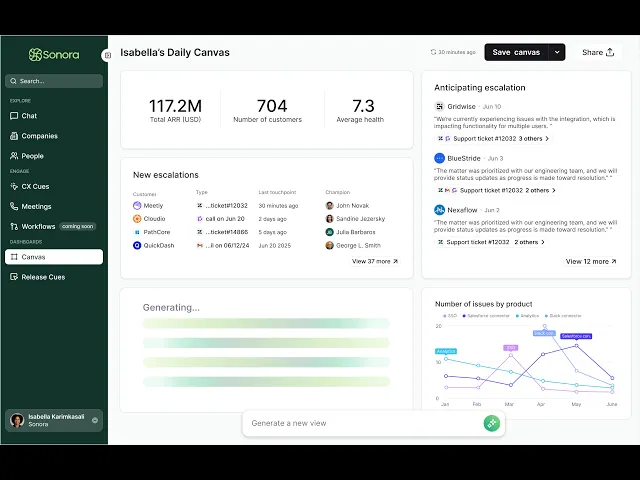
An AI-native platform changes this entirely. Customer health, product usage patterns, risk signals, relationship dynamics — all of it becomes accessible to everyone who needs it, in the context they need it. Your head of product can see which features are driving retention before the CSM writes their weekly update. Your CEO can understand account risk before the QBR. Your AE can see expansion signals the moment they emerge.
Customer success stops being something a team does to customers and becomes something the entire company does with customers. Every person in the organization becomes an extension of the CS function, armed with the context they need to act when it matters.
This is what "company-wide CS" actually means in practice — not a cultural mandate to care about customers, but a technological shift that makes customer intelligence universally accessible and actionable.
Agents Replace the Data Treadmill
Perhaps the most immediate change is the least glamorous: AI agents are taking over the work of keeping customer data current.
Legacy customer success platforms turned CSMs into data janitors. Every handoff required manual CRM updates. Health scores needed to be recalibrated as customer circumstances changed. Stakeholder maps went stale after every reorg. Meeting notes had to be logged. Usage data had to be pulled and interpreted. Risk flags had to be assembled from signals scattered across six different tools.
This wasn't what anyone signed up for when they became a CSM. It wasn't what companies thought they were paying for either. But it consumed enormous time — time that wasn't going toward actual customer relationships.
AI agents now do this continuously and automatically. They listen to calls, read emails, track product usage, monitor support ticket sentiment, and surface changes in stakeholder influence — all without a human having to orchestrate it. The customer record stays current not because a CSM made time to update it, but because agents are always watching.
The downstream effects are significant. If AI is maintaining the data and surfacing the insights, CSMs can focus almost entirely on the work that actually requires human judgment: navigating complex stakeholder relationships, making strategic recommendations, advocating for customers internally, and building the kind of trust that doesn't survive being treated as a transaction.
The CSMs who thrive in this environment won't be the ones who are best at working their systems. They'll be the ones who are best at working with people.
What This Means for Your Organization
These three shifts don't happen in isolation. They reinforce each other. When agents maintain the data, everyone can trust the data. When everyone can trust the data, it makes sense to share it company-wide. When everyone has access to customer intelligence, the rationale for rigid pre/post-sales separation weakens.
The companies that figure this out first won't just have more efficient CS teams — they'll have a fundamentally different relationship with their customers. One where the entire company is paying attention, all the time, and the customer feels it.
That's not a modest operational improvement. That's a different kind of company.