Thought Leadership
Sonora Announcements
Role Compression Is Coming for Post-Sales — And That's a Good Thing

I've spent the better part of a decade at the intersection of product, data, and GTM — leading teams at MuleSoft, Salesforce, and Carta — launching 0→1 products now used by Fortune 100 companies. I've always been drawn to big industry problems, and the biggest one I see right now is happening in post-sales. That's why my co-founder and I are building Sonora, an agentic platform for CS teams that fuels retention and expansion. And our thinking on where this is all headed is shaped by a pattern we all watched unfold before — twice, actually.
A Brief History of Specialization
If you go back to Bell Labs in the 1950s and 60s, there was no meaningful distinction between "product" and "engineering." The same person who understood the hardware was figuring out what to build and why. There wasn't a PM writing a spec and handing it to a developer. There was just someone solving a problem.
Over the following decades, that collapsed into hyperspecialization. Product managers, designers, developers — each with their own tools, career ladders, and vocabularies. The product triad became gospel. And for a long time, it made a lot of sense. The problems got bigger, the systems got more complex, and dividing labor was the obvious way to scale.
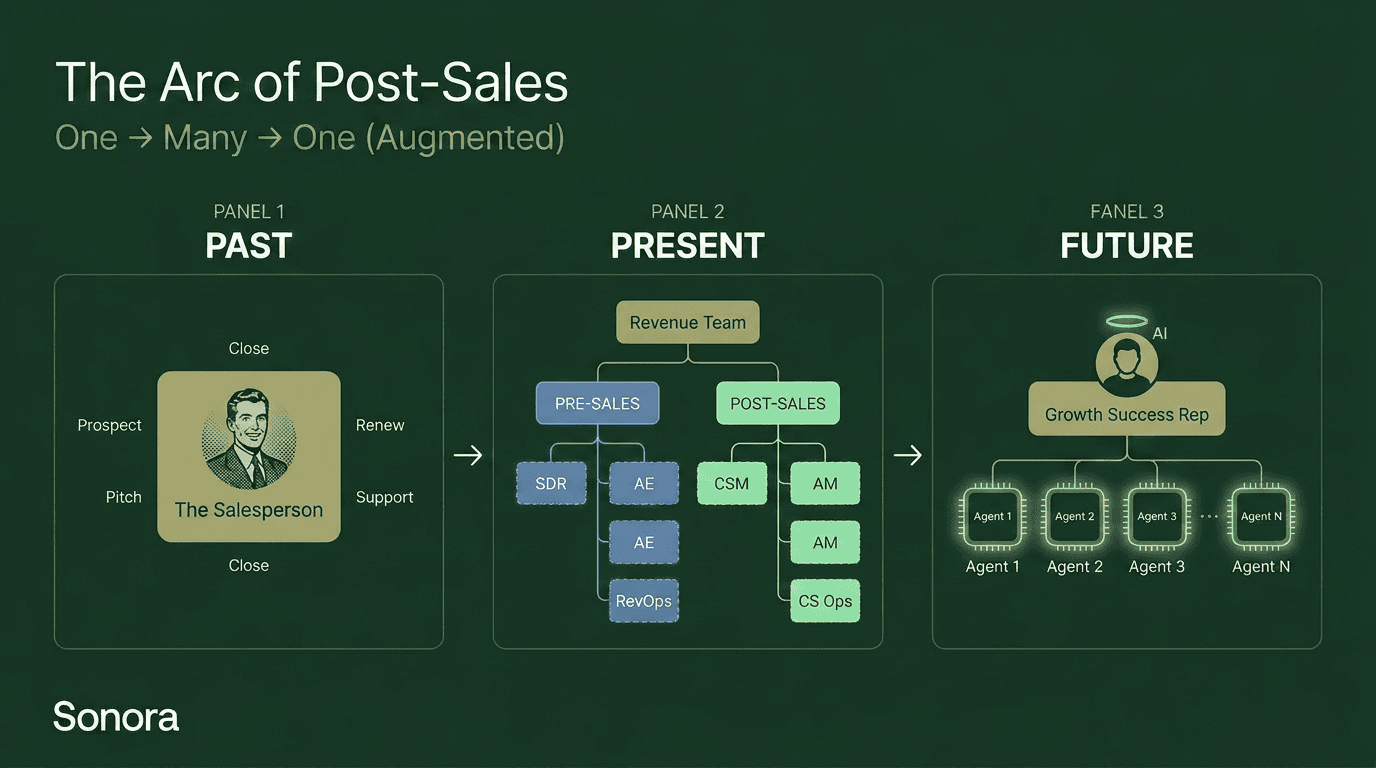
The same arc played out on the GTM side. Sales used to be one person doing everything — knocking on doors, cold calling, closing deals. Then Aaron Ross published Predictable Revenue in 2011 and it became the playbook for a generation of B2B companies. SDRs did outbound. AEs closed. CSMs owned post-sale. Account managers drove expansion. RevOps tied it together. Pre-sales and post-sales, neatly divided.
That model worked incredibly well for over a decade. But it's starting to change — fast.
The Compression
We're seeing role compression — AI collapsing these specialized functions back together. On the product side, where my co-founder and I come from, the shift is already well underway. Engineers run multiple AI agents in parallel to write code. PMs vibe-code prototypes. Designers ship working front-end components. The person who understands the problem is, once again, increasingly the person who builds the solution. It's starting to look a lot more like Bell Labs than anyone expected.
And the same thing is now happening in post-sales.
SDRs and AEs are using agents to automate prospecting and qualification. CS and account management are merging into what I've been calling "Growth Success" roles — where one person uses AI to manage both renewals and expansion. RevOps and data science teams are unifying customer knowledge into a single layer that agents can actually access. The clean separations that defined post-sales for over a decade are dissolving.
But I think it goes further than just the CS team. With agentic post-sales technology, everyone in the organization should have customer success as an extension of themselves. A PM preparing for a roadmap review should be able to ask an agent for the latest signals from their top accounts. A finance lead forecasting renewals should have the same depth of customer context as the CSM. The specialization walls don't just come down inside CS — they come down across the entire company. We call this "company-wide CS," and we believe it's where the industry is headed.
The Data Problem Nobody Wants to Talk About
The less obvious shift is what happens to all the stale data sitting inside CRMs and SaaS tools. For years, the burden of keeping these systems current fell on humans — manual data entry, field updates, pipeline hygiene. Every CS leader I talk to knows their data is incomplete. Almost none have the bandwidth to fix it. And yet, every AI initiative depends on that data being right.
This is the part most people miss. They focus on the models, the agents, the workflows. But agentic systems are only as good as the data they sit on. If the underlying context is stale or fragmented, the outputs are too. You're just generating noise.
We're building what we call a "customer knowledge graph." Instead of asking a CSM to log every interaction, agents parse the unstructured data — emails, call transcripts, support tickets, Slack threads — and structure it automatically. The CRM stops being a system of record that's always slightly wrong and becomes a living map of every customer relationship. That knowledge graph is what makes company-wide CS possible. It's the shared foundation that any agent, in any department, can query.
What We're Seeing at Sonora
That's what we're building at Sonora — an agentic revenue platform for post-sales teams. Our design partners include Carta, Kong, Ocrolus, Hint Health, and Merge. And the early results are concrete: our design partners are already seeing a 40% reduction in customer escalations, automation in 25% of no-risk renewals, and 30-second QBR prep.
For agents to return high-quality insights, you need two things: unified context across all your customer data, and well-structured prompts that capture best practices — things like QBR prep, health briefs, escalation summaries, churn analysis. We've spent a lot of time building and refining these prompt templates with our design partners. And as a give-back to the community, we've open-sourced over 20 of them. If you want access, email us at friends@usesonora.com and we'll send them over.
What Comes Next
We recently launched the Sonora Project — a series documenting how CS leaders at top tech companies are actually navigating AI. Not the vendor marketing. The real experiments, the wins, the false starts. The kind of stories that help the next generation of CS leaders understand what's actually working, beyond the hype and headlines. If that's interesting to you, we'd love for you to be part of it.
Role compression isn't something to fear. It's the end of artificial boundaries and the beginning of teams that can actually move at the speed their customers need.